Technical Contributor
$15,000+
- Instrumentation input
- Protocol development
- Data access
- Quarterly briefings
- Experimental objectives
These videos frame the core pilot question: what changes when irrigation delivery moves from short high-flow events toward continuous ultra-low flow operation?
Field evidence for a different question.
What if irrigation systems have been sized around infrastructure instead of the needs of the plant?
A well-instrumented site becomes a reusable validation platform.
In many cases, the information generated by a pilot may ultimately be more valuable than the hardware installed to conduct it.
Uses the pilot as a controlled field reference for comparing emitters, controls, pumps, filters, sensors, or system architecture.
Participate in the demonstrations and help define the next generation of irrigation assumptions.
Structured as increasing technical involvement. The middle pathway is intended for organizations that want a named role in the validation network.
$15,000+
$30,000+
$75,000+
| Participation | Level I | Level II | Level III |
|---|---|---|---|
| ● | ● | ● | |
Instrumentation input Review of measurement points, sensor selection, pressure and flow verification, soil moisture monitoring, telemetry needs, and calibration priorities before the site is documented. | |||
| ● | ● | ● | |
Protocol development Input on operating procedures for flow checks, pressure logging, reservoir drawdown, maintenance intervals, data collection cadence, and repeatable site documentation. | |||
| ● | ● | ● | |
Data access Access to archived time-series data, hydraulic summaries, field notes, photo and video documentation, and the assumptions used to interpret the demonstration results. | |||
| ● | ● | ● | |
Quarterly briefings Scheduled technical reviews covering site status, anomalies, operating constraints, preliminary findings, and the next questions the validation program should answer. | |||
| ● | ● | ● | |
Experimental objectives Participation in defining site-specific hypotheses, success criteria, measured variables, comparison cases, and the technical questions that should guide the pilot design. | |||
| ● | ● | ||
Publications visibility Named visibility, where appropriate, in technical reports, case studies, webinars, field summaries, and public-facing validation materials generated from the demonstration. | |||
| ● | ● | ||
Co-authorship opportunities Opportunities to contribute to white papers, technical notes, conference abstracts, or peer-reviewable work when the participant provides substantive technical input or analysis. | |||
| ● | |||
Multi-site programs Expansion of the validation protocol across multiple crops, climates, water sources, or operating environments to test whether the findings replicate beyond a single demonstration site. | |||
| ● | |||
Benchmark studies Structured comparisons against conventional irrigation architecture, pump and filtration assumptions, energy demand, distribution sizing, reservoir requirements, or monitoring methods. | |||
| ● | |||
Joint presentations Shared technical presentations for growers, agencies, engineering audiences, conferences, or network participants when the demonstration produces evidence worth presenting publicly. | |||
$15,000+
Includes:
$30,000+
Everything in Level I, plus:
$75,000+
Everything in Level II, plus:
Review of measurement points, sensor selection, pressure and flow verification, soil moisture monitoring, telemetry needs, and calibration priorities.
Input on operating procedures for flow checks, pressure logging, reservoir drawdown, maintenance intervals, data collection cadence, and repeatable documentation.
Access to archived time-series data, hydraulic summaries, field notes, photo and video documentation, and interpretation assumptions.
Named visibility, where appropriate, in technical reports, case studies, webinars, field summaries, and public-facing validation materials.
Opportunities to contribute to white papers, technical notes, conference abstracts, or peer-reviewable work when technical input is substantive.
Expansion of the validation protocol across multiple crops, climates, water sources, or operating environments.
Structured comparisons against conventional irrigation architecture, pump and filtration assumptions, energy demand, distribution sizing, or reservoir requirements.
Shared technical presentations for growers, agencies, engineering audiences, conferences, or network participants.
If this question deserves an answer, help produce the field evidence required to answer it.
Nano Flow Irrigation is establishing demonstration sites to evaluate continuous ultra-low flow irrigation at flow rates outside the range for which most irrigation systems were originally designed.
The objective is to determine where existing assumptions cease to apply.
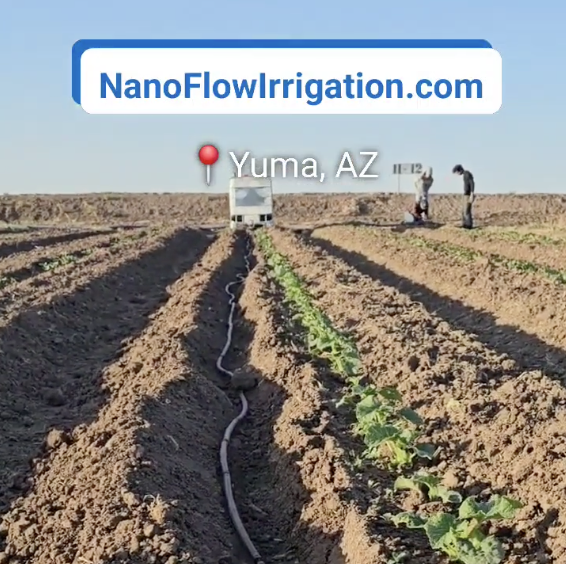
The Yuma benchmark trial evaluated Nano Flow Irrigation under changing field conditions, including variable source-water quality, gravity-fed operation, filtered refill, replacement hardware, and a later pressurized fertigation event.
Because several operating variables changed during the trial, the record is being reviewed as a sequence of technical phases rather than treated as one continuous controlled experiment.
Nano Flow Irrigation was installed using untreated agricultural reservoir water under gravity-fed conditions.
The initial phase produced important observations related to water quality, operating pressure, and ultra-low flow field performance.
The system was reset with replacement line and a filtered water supply.
This phase provided additional information on source-water conditioning, gravity operation, and the effect of changing multiple variables during a field trial.
The line was later exposed to UAN-32 through the field irrigation system under a separate pressure condition.
This created useful follow-up questions involving pressure, fertilizer chemistry, nutrient arrival, filtration sequence, flushing, and system recovery.
The trial identified practical variables that should be controlled more precisely in future validation, including source-water characterization, filtration sequence, stable operating pressure, fertilizer injection location, pre- and post-treatment flow measurement, sample retention, restriction analysis, and outlet conditions.
A complete interpretation requires review of the trial chronology, water-handling changes, pressure conditions, and fertigation event together.
This validation program is an investigation into accepted industry standard irrigation assumptions, not merely a new emitter specification.
Less pressure loss means better uniformity.
Review validation pathways
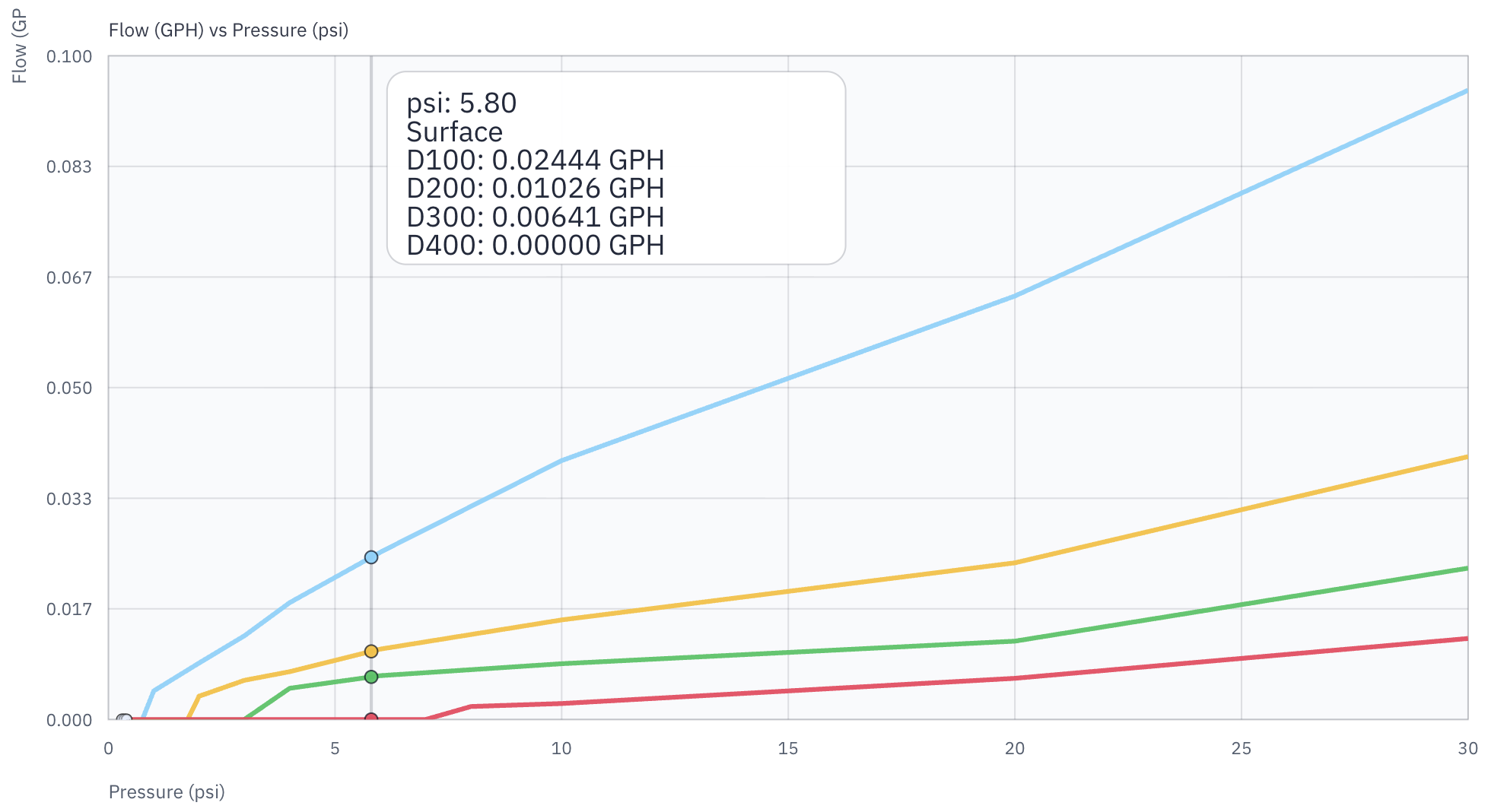
Each emitter in The Dropper Series is designed to operate at flow rates well below conventional drip ranges.
That steady low-flow delivery lets a site test whether infrastructure can shrink when irrigation moves from short events toward continuous operation.
Model a pilot system
Founder Conversation
CEO & Founder
This validation network is for organizations that want to pressure-test conventional assumptions.
Book a live chat